Lead Like an Artist
Why Creativity Matters in an Age of Radical Disruption
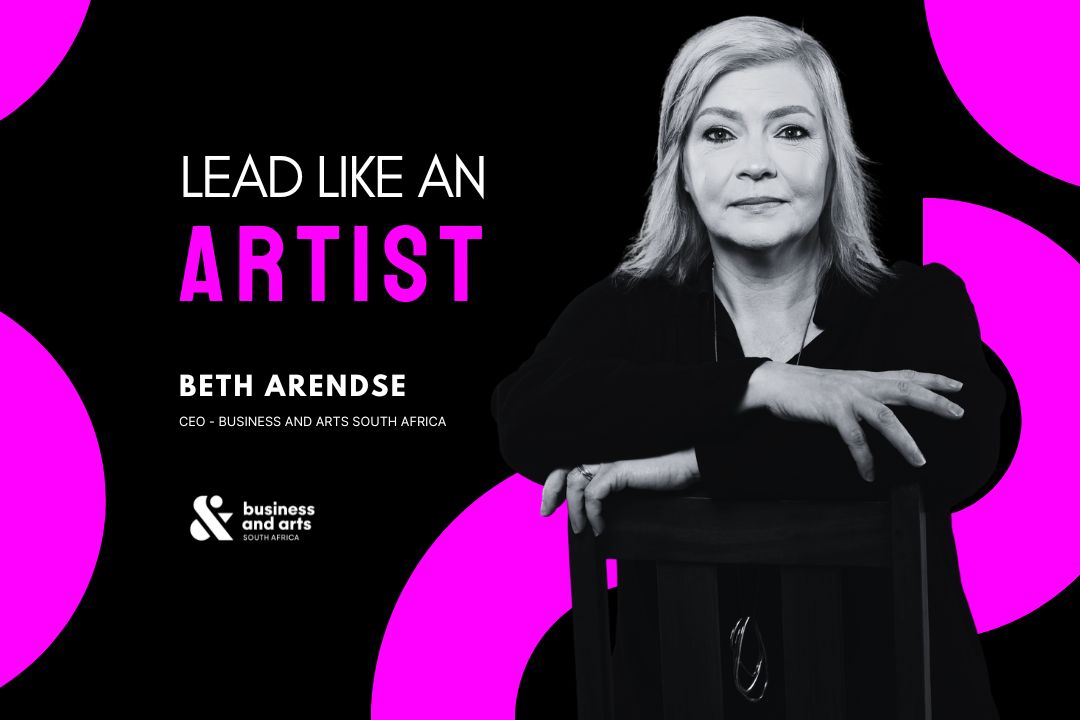
I was recently asked to speak at a creative and cultural leadership programme for young policy shapers. Preparing for that moment triggered an unexpected realisation. I had never consciously articulated my own leadership journey – or even considered myself a leader.
A trailblazer? Yes. An entrepreneur? Absolutely. A social innovator? Definitely on that road. But a leader? That label had always felt slightly uncomfortable.
As I sat with that discomfort, I realised why. The dominant frames of leadership I had been exposed to – hierarchical, linear, command-and-control – had never fitted me. So I decided to step back and articulate my own leadership philosophy by looking honestly at how I move through the world and how I work.
And then it hit me.
I lead like an artist.
What it means to lead like an artist
Leading like an artist is intuitive and iterative. It is deeply aware of the collective and conscious of impact beyond the self. It understands that the strongest improvisation is only possible when there is a solid underlying structure.
In music, a strong chord structure allows for freedom. You can stretch, explore, and take risks because you know where home is. You resolve back to the tonic for closure. You leave space – enough openness so the work never has rigid boundaries, allowing it to become what it needs to be. But that freedom is held by discipline, technical mastery, and deep listening.
Sometimes you are the conductor. Sometimes you are part of the orchestra. Sometimes it is your turn to solo – and sometimes the most powerful choice is knowing when not to.
You work in the moment. You feel the rhythms – your own and the larger song you are part of. You respond to what is emerging, not only to what was planned.
These are not soft skills. They are highly developed capabilities.
Creativity as the common thread
All of these traits share a single foundation: creativity.
Creativity is the ability to bring something into being that does not yet exist – using the fragments, constraints, and possibilities visible in front of you. It is expansive, but not careless. Flexible and adaptive, yet principled. Open to learning in motion, while grounded in a strong sense of purpose and structure.
This is why creativity always precedes innovation. Innovation is the outcome; creativity is the condition.
I have often wondered whether this is why our innovation indicators remain lower than they should be as a country. Perhaps it is because we do not prioritise creativity as a core skill, a leadership mindset, and a way of being in an increasingly complex and chaotic world.
We talk about technology, efficiency, and scale – but without creativity at the centre, these tools struggle to deliver meaningful, human-centred impact.
Creativity is no longer a function – it’s a way of leading.
A New Era
Technology, for all its power, is ultimately an enabler of human endeavour. We design it, we deploy it, and the quality and impact of what it produces depends entirely on how we choose to use it. In a world experiencing unprecedented change, upheaval, and systemic disruption, this distinction matters more than ever.
We are living through a moment not unlike the Renaissance – a period of profound transition where old systems are breaking down and new ones are still forming. In times like these, incremental leadership is not enough.
What is required is a different kind of leadership altogether – one that foregrounds creativity, draws on cross-sectoral expertise, and is grounded in systems thinking. During the Renaissance creative leadership was prized. Polymaths (someone who connects knowledge across domains) like Leonardo da Vinci moved seamlessly between art, science, engineering, and civic life, valued for their ability to think across boundaries and hold ambiguity. History repeats this pattern: during the Islamic Golden Age, scholars integrated mathematics, medicine, astronomy, and culture; in the Enlightenment, thinkers blended philosophy, science, and political theory; and in periods of decolonisation and nation-building, cultural leaders helped societies reimagine identity and futures. In every case, leaders who could imagine what did not yet exist while navigating present constraints shaped the course of history.
A leadership moment
Perhaps creativity’s time has come.
Perhaps those of us who never quite fitted the traditional leadership mould were not failing the system – the system was simply no longer fit for purpose. In this moment of transition, there is a gap opening up. A space that requires leaders who are comfortable with ambiguity, capable of synthesis, and willing to work across disciplines, sectors, and worldviews.
Those leaders are already here. Many of them just haven’t called themselves leaders yet.
If the world ahead is being written in real time, then we need leadership that can compose, improvise, listen, and respond – all at once.
So maybe the invitation is simple:
Lead like an artist.
I have a feeling it’s going to get us places.
Beth Arendse
CEO – Business and Arts South Africa