Johannesburg, – Business and Arts South Africa (BASA) held its 2026 Annual General Meeting (AGM) as a moment of reflection, accountability and renewed momentum, bringing together members, partners, Board members and stakeholders to consider the organisation’s progress during the 2025/26 financial year and the next phase of its work.
The meeting told the story of an organisation repositioning for long-term relevance: strengthening governance, deepening partnerships, widening access to its networks and placing sustainability at the centre of its strategy for the creative economy.
Since taking office in July 2025, BASA CEO Beth Arendse has led the organisation through a period of repositioning under its AMPERSAND Strategy 2030, which seeks to strengthen BASA’s role as a connector and catalyst between business, government, investors and the creative economy.
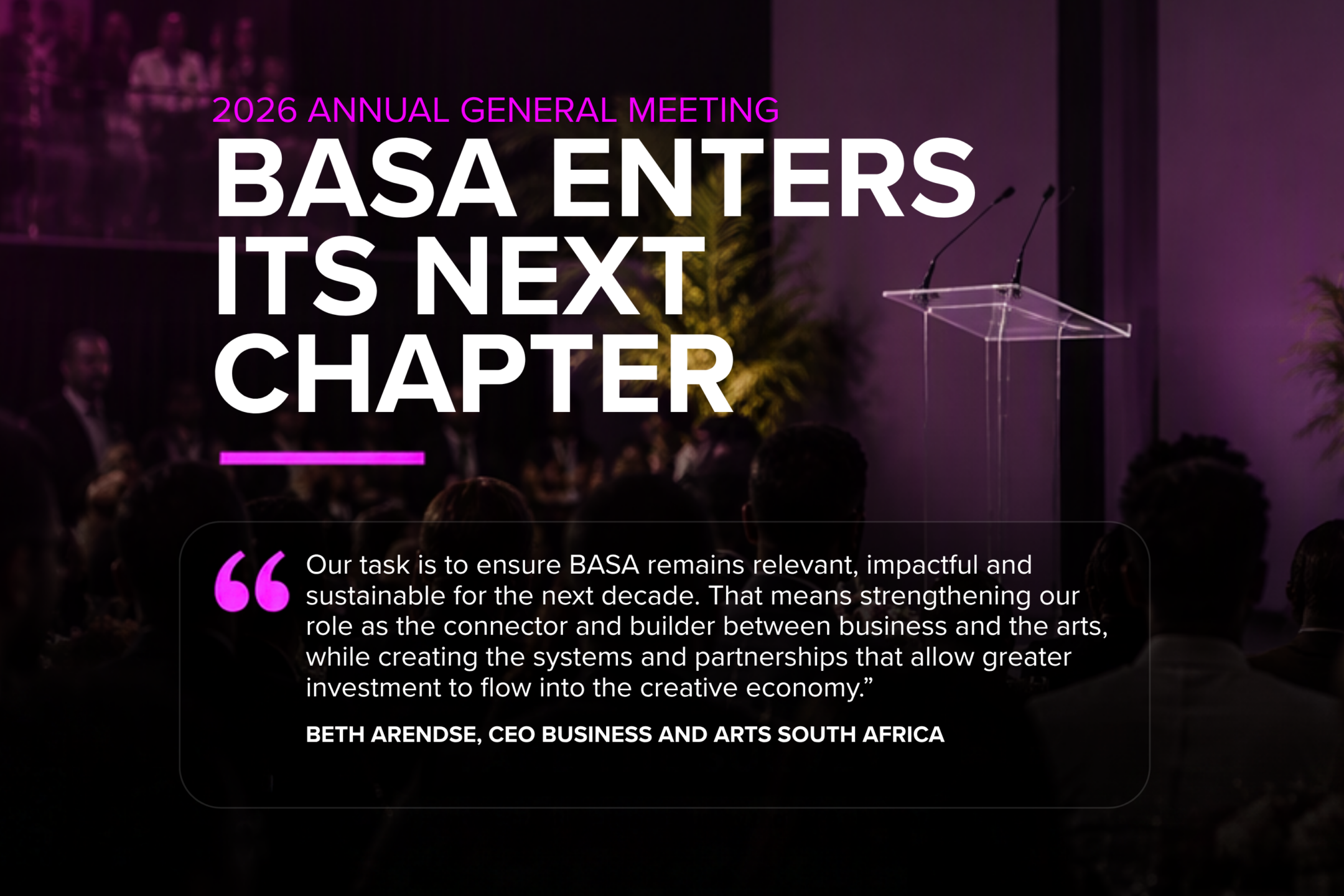
“Legacy alone will not carry an institution forward,” said Arendse. “Our task is to ensure BASA remains relevant, impactful and sustainable for the next decade. That means strengthening our role as the connector and builder between business and the arts, while creating the systems and partnerships that allow greater investment to flow into the creative economy.”
This focus was sharpened by a changing funding environment, including reduced government grant income during the 2025/26 financial year. Rather than slowing its ambitions, BASA used the shift to accelerate work already under way to build a more resilient, diversified and partnership-led financial model.
As part of this work, BASA reviewed its internal systems, while advancing an income diversification strategy designed to support a more sustainable future.
The AGM reported an unqualified audit outcome, reinforcing BASA’s continued focus on sound governance, accountability and responsible stewardship.
This governance work provides the foundation for BASA’s next phase as it approaches its 30th anniversary, ensuring that the organisation’s programmes, platforms and partnerships are supported by stronger systems and clearer pathways for growth.
One of those pathways is BASA’s reimagined membership model, which introduces a free Connect tier alongside paid membership options. The model is designed to widen access to BASA while creating stronger routes for businesses and creatives to meet, collaborate and build partnerships.
BASA is also developing a new CRM platform to strengthen how it manages relationships, communicates with its community and delivers value to members.
The organisation has further advanced work around its Creative Supplier Directory, with the longer-term ambition of creating stronger pathways between creative businesses and corporate procurement opportunities.
The same strategic focus is guiding BASA’s reimagined Supporting Grants model, which builds on a programme that has leveraged more than R590 million in private sponsorship against R46 million in grants over more than two decades. The new approach introduces catalytic grants designed to seed prototype partnerships and extend BASA’s reach beyond its traditional geographic base. The first pilot supported 11 projects, including initiatives led by small and medium-sized businesses and projects in under-represented areas. The pilot demonstrated the potential of catalytic investment to unlock additional value, with BASA’s R1 million investment attracting a further R369,000 from business.
Alongside its grants work, BASA continued to invest in the people and enterprises shaping the creative economy. Through the Debut Fund programme, delivered in partnership with the Department of Sport, Arts and Culture, BASA supported young creative entrepreneurs through a journey focused on creative development, entrepreneurship and the business of building sustainable creative enterprises.
The programme supported 450 young creative entrepreneurs, with the top 53 progressing into intensive mentorship.
BASA’s commitment to building a stronger creative economy also extends to knowledge, dialogue and thought leadership through Creative Futures Africa (CFA), a pan-African platform for dialogue, connection, knowledge and action across the sector. The platform has developed beyond a single annual gathering, creating ongoing opportunities for decision-makers, thinkers and leaders to engage with the questions shaping Africa’s creative future.
The 2026 CFA Summit in Johannesburg, themed “From Unseen to Unstoppable”, brought together voices from across the creative economy, business, finance, technology, policy, climate and city-making.
BASA’s role as an anchor partner reflects its broader ambition to convene conversations, catalyse coordination and strengthen connections across the ecosystem, while driving the conversation around developing the architecture the creative economy needs to scale.
This ecosystem-building approach was also reflected in BASA’s partnerships during the year, including its collaboration with Canva, which supported digital capability and generated insights within the creative economy, and the Creative Youth Policy Lab, delivered with the British Council, which created space for young creatives to engage with policy and contribute to conversations shaping their future. The organisation also launched its Executive Programme in Arts Governance and continued its collaboration with the Industrial Development Corporation (IDC).
These initiatives form part of BASA’s broader effort to move the conversation around the arts beyond traditional funding models and towards meaningful business partnerships, investment, skills, innovation and procurement.
Looking ahead, BASA’s focus will be on turning the infrastructure established during the year into greater scale, stronger partnerships and measurable impact across the creative economy.
This includes growing its corporate base, launching its new member platform, strengthening the Creative Supplier Directory as a procurement pathway and expanding the Supporting Grants model into under-represented provinces.
As BASA approaches 30 years, the organisation is entering its next chapter with a clear focus on Partnerships, Insights, Sustainability and Impact.
Together, these developments show BASA entering its next chapter with clarity and purpose: strengthening its role as the connector and builder between business and the arts, and creating the conditions for greater investment, collaboration and shared value across South Africa’s creative economy.
View Annual Report HERE
Media Enquiries
Sinenhlanhla Mdiya
Marketing & Communications
sinenhlanhla@basa.co.za