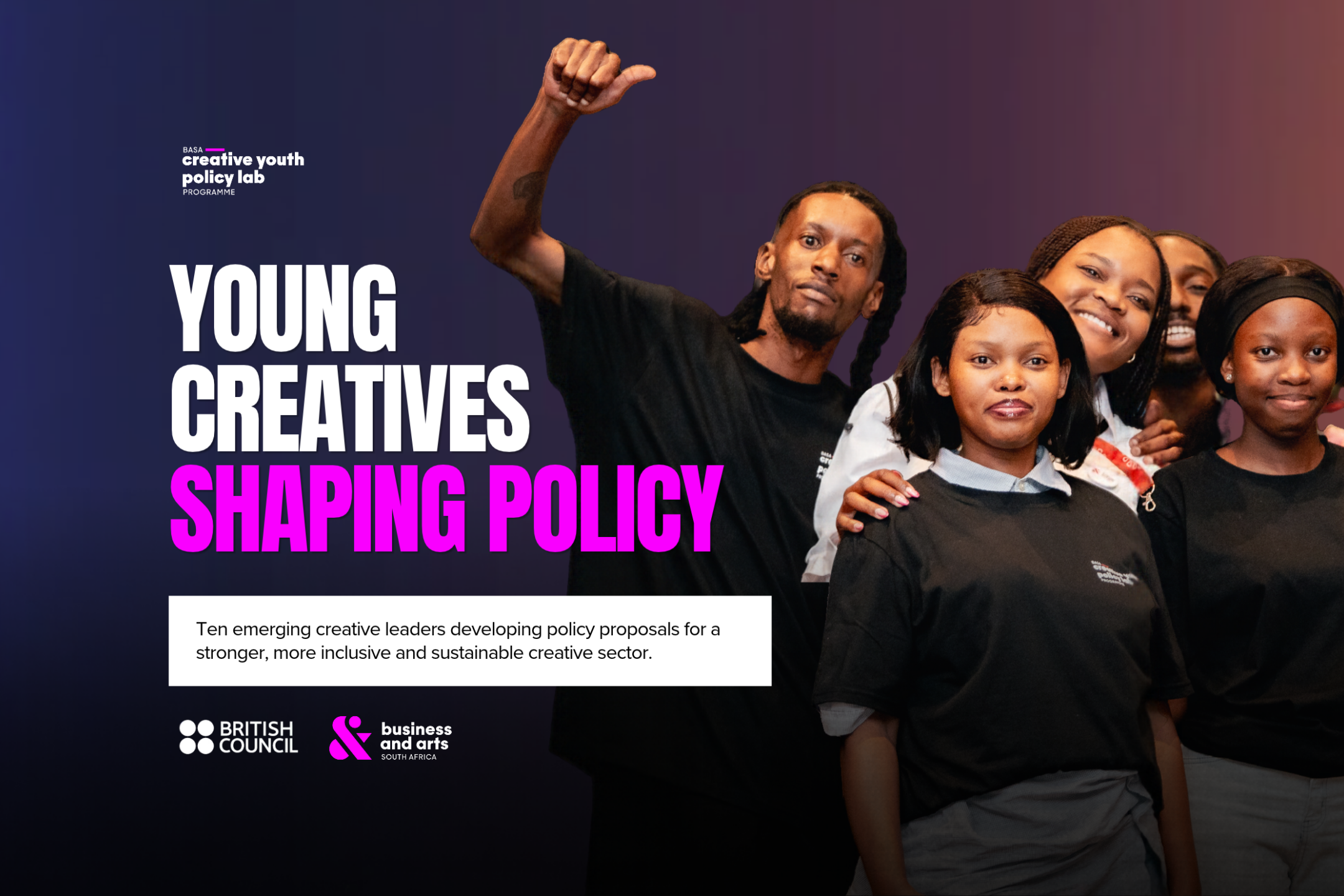
JOHANNESBURG, SOUTH AFRICA – Ten young creatives participating in the Creative Youth Policy Lab (CYP Lab), a programme delivered in partnership by Business and Arts South Africa (BASA) and the British Council, have developed two policy proposals aimed at addressing language recognition and improving working conditions for creative workers in South Africa.
Presented to decision-makers at the Creative Futures Africa Summit in Johannesburg in September 2026, the proposals call for the recognition of Nama and consideration of its officialisation as South Africa’s proposed 13th official language, alongside a more formalised and professionalised framework for creative workers that addresses access to relevant social protection.
The proposals reflect the cohort’s effort to move beyond identifying challenges towards developing recommendations that can inform policy dialogue, advocacy and decision-making.
“Being part of the Creative Youth Policy Lab is an opportunity to actively contribute to solutions and understand how change happens. It has given me insight into how I can make a difference within my sphere of influence, while creating space to engage directly with decision-makers and ensure that the perspectives of young creatives are heard and considered,” said Mzoxolo Vimba, a participant in the Creative Youth Policy Lab.
The Creative Youth Policy Lab creates opportunities for young creatives to engage with the policies, institutions and decisions that shape their careers and the wider creative economy. Through research, collaboration and practical policy exercises, participants explored challenges affecting their communities and developed proposals informed by lived experience and evidence. The programme included stakeholder mapping, active listening, mock policy hearings, future-scenario exercises and collaborative policy drafting. These activities helped participants understand how policy is developed and how they can contribute to decision-making processes.
The first proposal, Language Is Infrastructure – Officialising Nama as South Africa’s 13th Official Language, calls for greater recognition of Nama and consideration of its officialisation. It positions language as integral to cultural identity, heritage and participation in public life, highlighting the importance of recognising communities whose languages and knowledge systems have historically received limited institutional recognition. The proposal invites policymakers to consider how greater recognition of Nama could contribute to cultural preservation and inclusion. It is a recommendation for consideration and does not reflect a change to South Africa’s current official-language status.
The second proposal, Creative Workers Are Workers Too: Building a Formalised and Professionalised Framework for Creative Workers with Relevant Social Protection, examines the working conditions of people across the cultural and creative industries. Many creative workers navigate irregular income, short-term projects and limited employment protections. The proposal identifies challenges including late or inconsistent payments, unpaid preparation and administrative work, a lack of standardised contracts, limited access to medical aid and retirement provision, and barriers to legal and business support.
These challenges affect freelancers, independent cultural organisations, curators, cultural project managers and practitioners at different stages of their careers. They can be particularly pronounced in rural, township and peri-urban communities, where access to professional networks and resources may be limited.
The proposal highlights the gap between the economic contribution of the creative industries and the protections available to the people who generate that value. Drawing on existing policy foundations, including the 1996 White Paper on Arts, Culture and Heritage and the 2022 Cultural and Creative Industries Masterplan, it calls for greater attention to the contractual, economic and social conditions needed to sustain creative work and livelihoods.
Together, the proposals highlight two priorities for the creative economy: recognising and protecting cultural identity and strengthening the conditions under which creative workers live and work.
The Creative Youth Policy Lab creates a pathway for young people to participate meaningfully in policy development. By equipping young creatives with the tools to research, deliberate and develop proposals, we are helping bring their perspectives into conversations that shape the future of the creative economy. The next step is to ensure these proposals receive consideration and contribute to ongoing dialogue and action. The presentation of the proposals at the Creative Futures Africa Summit brought young creatives’ perspectives into a broader conversation involving policymakers, investors, business leaders and cultural practitioners on the conditions needed to grow Africa’s creative economy.
For BASA and the British Council, the programme highlights the importance of creating meaningful opportunities for young people to participate in policy development. Beyond consultation, this requires pathways for young creatives to engage with decisionmakers, contribute to policy discussions and remain involved as recommendations are considered.
As the proposals progress, continued dialogue and engagement will be important in ensuring that the issues raised receive consideration and contribute to future policy discussions.
For media enquiries:
Sinenhlanhla Mdiya
Marketing & Communications
sinenhlanhla@basa.co.za