When I joined BASA, I often asked a simple question: how many talented creatives never enter the industry, not because they lack ability, but because access to opportunity is uneven?
Three years into working on the Debut Fund Programme, that question has become clearer. It is no longer theoretical, but a system reality.
What we have learned is that funding alone does not remove barriers. Access does.
The deeper constraints sit in networks, in information flows, in production ecosystems, and in the informal rules that shape who gets seen, supported, and sustained in the creative economy.
The Debut Fund Programme, delivered in partnership with the Department of Sport, Arts and Culture, was designed as more than a funding mechanism. It is an entry point into the creative economy that combines financial support with mentorship, production enablement, and industry navigation.
In practice, this shift becomes visible in how creatives move through the system. A fashion designer from Soweto gains access not only to funding but to suppliers and industry relationships that open doors to platforms such as Joburg Fashion Week. A theatre-maker from Gqeberha strengthens production and business capability, leading to a sold-out run and a second commission. A visual artist in a rural area accesses a redesigned low-data application system, which expands who the programme is able to reach.
These are not isolated success stories. They are evidence of what changes when systems are designed for access.
Exclusion is rarely about talent. It is about networks, information asymmetry, informal gatekeeping, lack of mentorship and production support, and practical constraints such as space, legal support and care responsibilities.
This is why the programme has evolved beyond funding to include structured mentorship and industry navigation support, ensuring creatives are not only resourced but connected.
Success is also being redefined. It is no longer measured only by outputs, but by the expansion of access itself, including how many new doors are opened and how many are held open for others.
One young musician recently said after her first paid performance that she did not know people like her were invited into those spaces. She is now mentoring others.
That is what a cycle of access looks like.
For business and government, the implication is clear. Creative economy programmes are not charity. They are ecosystem investments.
When access improves, the entire system strengthens, from cultural production to jobs, exports and local value chains.
As we prepare for the next round of the Debut Fund Programme, the focus remains simple. Widen access where it is most constrained.
Because breaking barriers is not about lowering standards. It is about removing unnecessary gates.
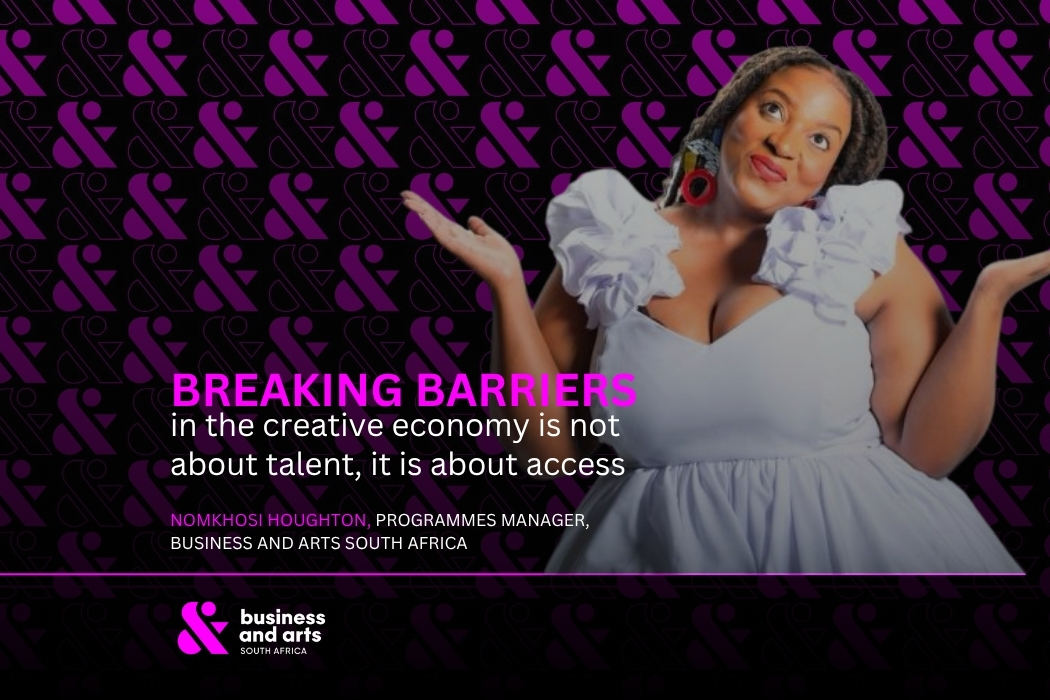
By: Nomkhosi Houghton, Programmes Manager, Business and Arts South Africa (BASA)