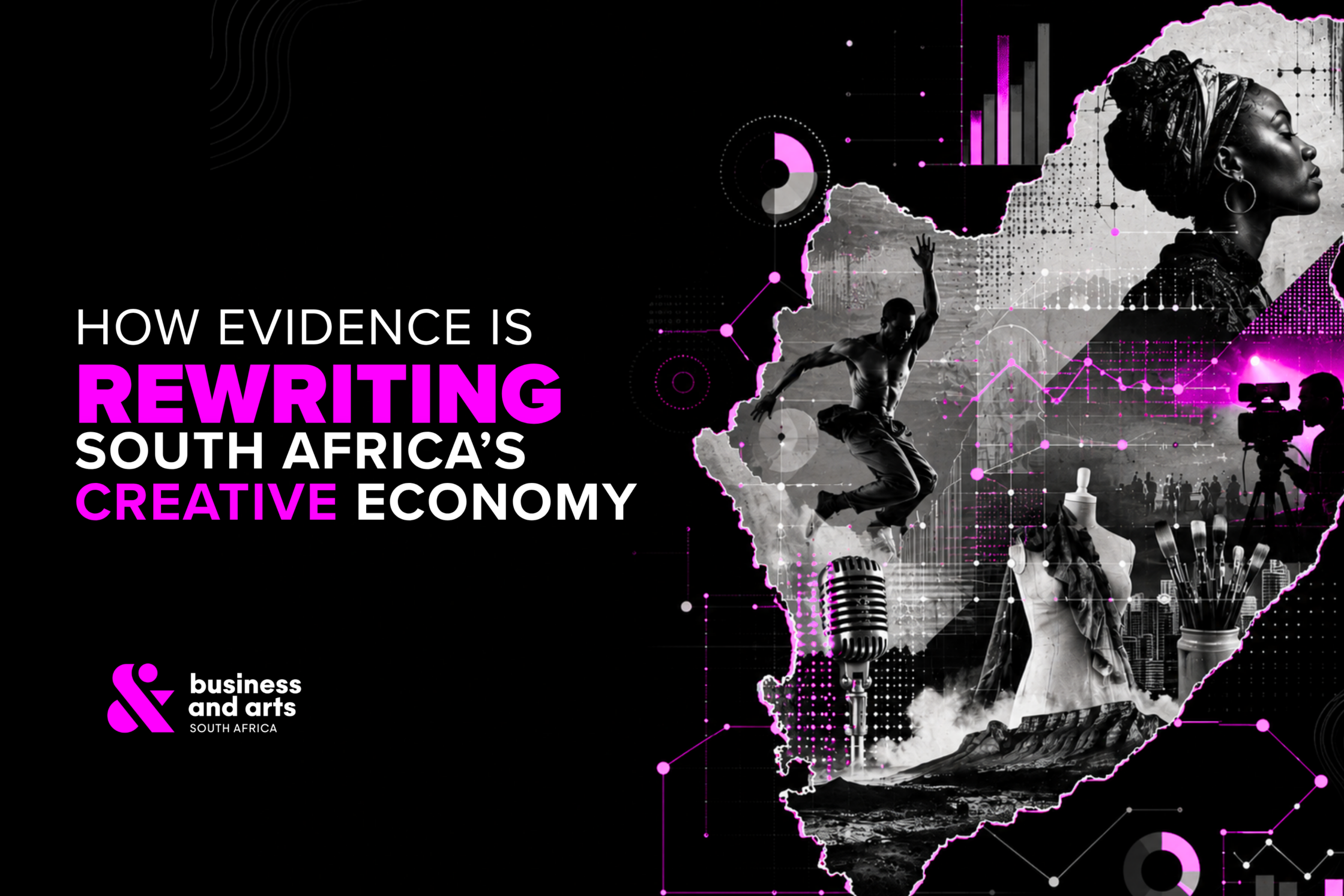
How Evidence Is Rewriting South Africa’s Creative Economy
I love the South African Cultural Observatory’s (SACO’s) mapping studies. Call me a research nerd, but there is nothing more satisfying than curling up with a good dose of cultural statistics.
But SACO isn’t alone.
Over the past decade, a growing body of research has been quietly – and sometimes loudly – reshaping how South Africa understands its creative economy. From SACO’s national mapping work, to industry reports, policy reviews, labour studies, and value chain analyses produced by universities, agencies, and sector bodies, data has become one of the most powerful tools the creative sector has ever had.
I remember how much that mattered to me personally.
When data became a weapon
In 2018, I was trying to position my creative business in a world that still saw us as those “song and dance people” – culturally interesting, socially useful, but economically frivolous. I needed to convince investors and non creative decision makers that creativity deserved serious, mainstream investment capital.
What shifted those conversations wasn’t passion or persuasion alone. It was evidence.
Research emerging at the time – particularly the early creative economy mapping studies – gave us a way to translate creativity into economic language. Employment figures. GDP contribution. Enterprise density. Growth potential. Suddenly, I could show that the creative economy employed more people than mining and roughly as many as agriculture. I could demonstrate that this was a labour intensive, opportunity rich sector with real multiplier effects.
That data didn’t just support my pitch – it legitimised the sector.
Arguing for entrepreneurship in the arts
At the same time, I was fighting another battle: trying to establish business development and incubation support for creative enterprises. Entrepreneurship, market access, and enterprise growth were still viewed with suspicion by parts of the arts funding ecosystem. The dominant narrative framed creativity as something that needed protection from markets, rather than intelligent participation in them.
Again, research helped shift the ground.
Studies consistently showed a sector dominated by micro enterprises, freelancers, and informal operators. They highlighted structural precarity, weak access to finance, fragmented markets, and skills gaps – but also extraordinary entrepreneurial drive. The implication was unavoidable: without targeted enterprise support, the creative economy would remain stuck in survival mode, regardless of talent or cultural richness.
Across multiple reports and datasets, a new story began to form. Creative practitioners were not only artists; they were economic actors navigating complex value chains with very little infrastructure.
A sector grows up
Fast forward nearly eight years.
Today, I sit as CEO of Business and Arts South Africa, working to drive investment into the arts and position creativity as a core component of South Africa’s economic infrastructure. That shift mirrors what has happened more broadly across the sector.
The conversation has changed.
Creative economy research now informs industrial policy, urban regeneration strategies, innovation frameworks, and inclusive growth agendas. We speak with greater precision about subsectors, regional dynamics, digital disruption, export potential, and transformation challenges. We understand that creativity intersects with tourism, technology, education, and social innovation in ways that are both measurable and investable.
Recent mapping and analytical work no longer asks whether the creative economy matters. It asks how we build systems that allow it to scale – through finance instruments, skills pipelines, market access platforms, and institutional coordination.
At BASA, this shift has directly informed how we position our own work. We are increasingly prioritising insights and advocacy as a core organisational function – moving towards a more structured cadence of monthly and quarterly engagements that surface data, interrogate trends, and translate research into practical, actionable pathways for the sector. For us, data is not only reflective; it is a tool for alignment, influence, and decision-making across the ecosystem.
This is also reflected in our role as anchor partner of Creative Futures Africa, a pan-African platform designed to frame, convene, and catalyse conversations around the future of the creative economy. A key part of this work is the intentional generation and mobilisation of insights: bringing together data, practice, and policy to ensure that what we know about the sector can be translated into strategies that practically advance creative economy objectives across the continent.
What the research tells us
Looking across years of creative economy research, the evolution is clear:
• From anecdote to evidence
• From advocacy to strategy
• From defending value to designing systems
• From marginal activity to economic infrastructure
This is why ongoing research matters so deeply. It doesn’t just describe the sector at a moment in time – it tracks its maturation. It gives practitioners, funders, policymakers, and investors a shared language and a common reference point for action.
For those of us who have been in this work for years, the data tells a story of persistence, progress, and possibility. It shows how far we’ve come – and how much more intentional we need to be about where we’re going.
So yes – call me a research nerd.
Because, as I’ve learned again and again, there is nothing sexier than data.
Beth Arendse
CEO – Business and Arts South Africa